TH-01.2 – 25-step learning and project guide
Inhaltsverzeichnis
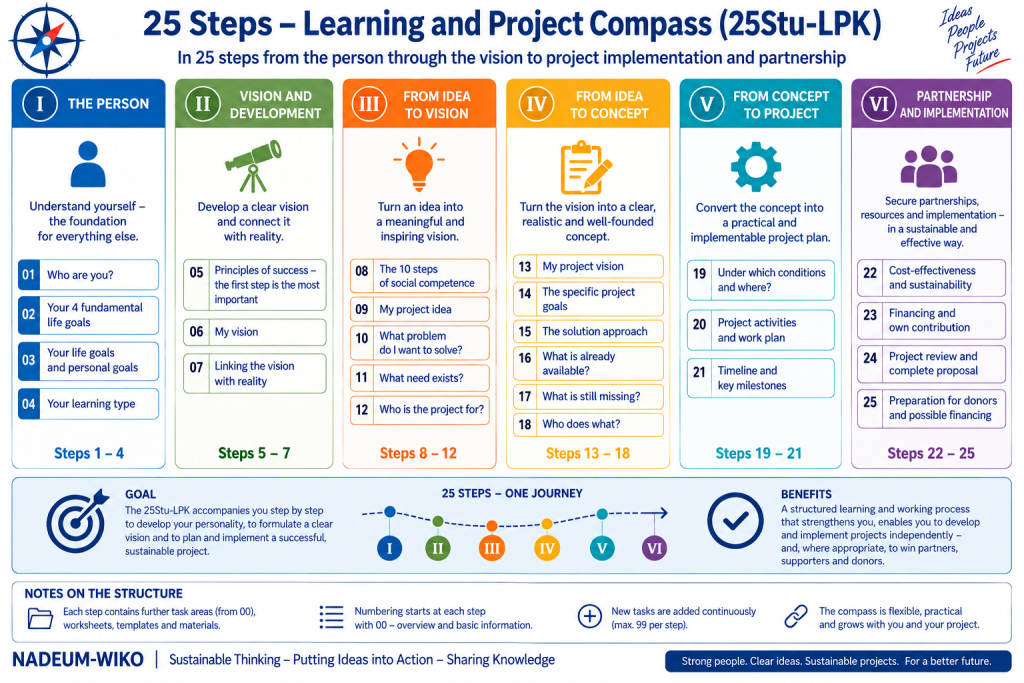
From personality to vision – from idea to project
The 25-Step Learning and Project Compass (25Stu-LPK) is a structured learning, development and project process.
It helps individuals, groups and organisations to understand themselves and their starting point, develop their own goals and visions, turn ideas into viable concepts, and use these to plan and implement concrete projects. The aim is not simply to fill in a project application as quickly as possible. The 25Stu-LPK guides users step by step through a learning and development process:
Learning → Understanding → Reflecting → Developing → Planning → Acting → Evaluating → Further developing
A key principle is:
The compass remains the same. The path through the compass is adapted to the stage of development of the individual, organisation or project in question.
The 25 steps therefore form a shared basic framework. The specific tasks, worksheets, discussions and outcomes may vary depending on the individual, group, organisation and project.

The 25Stu-LPK is a learning process – not a questionnaire
The 25 stages are not simply completed one after the other as quickly as possible.
Each stage may consist of various tasks, worksheets, discussions, practical exercises and reflections.
Participants initially work independently, discuss their findings with other participants and/or a coach, and record different perspectives and insights.
NADEUM-WIKO supports and structures the process – responsibility for participants’ own decisions, their own contributions and the implementation of the process remains with the participants or the respective organisation.
The long-term aim is for participants, following appropriate support, to be able to use the 25Stu-LPK independently for their future development and project initiatives.
CHAPTER I – THE INDIVIDUAL
Understanding oneself – the foundation for everything that follows
Before a person can develop a project or take on responsibility for others, they should first understand who they are, what motivates them, what their goals are, how they learn, and where their own strengths and areas for development lie. This first chapter therefore forms the personal foundation of the entire 25Stu-LPK. The aim is not to evaluate a person or to categorise them. Rather, it is to enable them to get to know themselves better and to assess their own starting point realistically. This involves, amongst other things, considering their personal life situation, experiences, knowledge, skills, limitations, fundamental life goals and personal objectives.
One’s own learning style also plays an important role. After all, anyone who knows how they learn best, process information, make decisions and deal with challenges can shape their own development process more consciously.
The four stages of this chapter
01 – Who are you?
Recognising oneself, one’s background, experiences, knowledge, skills, strengths and areas for development.
02 – Your 4 fundamental life goals
Understanding your personal fundamental life goals and reflecting on their significance for your own life.
03 – Your life goals and objectives
Recognising your own goals, needs, values, talents and priorities, and relating them to one another.
04 – Your learning style
Gaining a better understanding of your preferred way of learning, how you deal with challenges and your personal development opportunities.
The aim of this chapter
The aim is not simply to end up with a completed questionnaire.
Participants should be able to say:
“I have a better understanding of where I stand, what matters to me, what I’m capable of, where I’d like to develop, and how I learn best.”
This self-awareness forms the basis for the following chapters.

CHAPTER II – VISION AND DEVELOPMENT
Developing a clear vision and linking it to reality
Having considered one’s personal starting point, the second chapter addresses the question:
‘Where do I want to go?’
A vision does not arise from a mere wish alone. It must be linked to one’s own personality, one’s own capabilities and one’s actual life situation. That is why this chapter begins with fundamental principles for personal development and responsibility. Next, we examine your own vision: How do I want to live in the future? What do I want to develop? What do I want to change? What significance do personal, professional, financial and social aspects hold? The vision is then compared with reality. After all, there can be a significant gap between the future you desire and your current situation.
The 25Stu-LPK helps to make this gap visible:
Where am I today?
Where do I want to go?
What is missing?
What do I need to change myself?
What do I need to learn?
What obstacles are there?
What opportunities and resources are already available?
The three stages of this chapter
05 – Principles of Success – The first step is the most important
Taking responsibility, making decisions, taking action, drawing on experience and learning from mistakes.
06 – My Vision
Develop a personal vision of the future you desire.
07 – Aligning the Vision with Reality
Compare your own vision with your actual starting point and identify the necessary steps for development.
The aim of this chapter
A general desire should evolve into a conscious and realistically considered vision.
A vision does not mean that a finished plan already exists. It initially describes the direction in which development should lead.
CHAPTER III – FROM IDEA TO VISION
Understanding an idea, examining it and getting to its very core
This is where the transition from personal development to potential project development begins. People often have ideas. However, an idea on its own is not yet a project.
That is why we first examine:
What exactly is my idea?
What change should it bring about? What problem lies behind it? What is the actual need? And who would actually benefit from a potential solution? An important component of this chapter is therefore the 10-step social skills framework. It helps participants to better understand themselves, other people, communication, responsibility, conflicts and goal-setting. The project idea is then examined step by step. In doing so, a distinction must be made between assumptions and information that has actually been verified.
For example:
What is the real problem?
Who is affected by it?
What are the causes?
What need exists?
What information is already available?
What has been tried so far?
Who is the project intended to benefit?
The five stages of this chapter
08 – The 10 stages of social competence
Fundamentals for self-awareness, communication, collaboration, conflict resolution and taking responsibility.
09 – My Project Idea
Describe your own idea and understand its starting point.
10 – What problem do I want to solve?
Examine the specific problem and its causes.
11 – What is the need?
Identify the actual need and, where possible, verify it using information, observations or other suitable sources.
12 – Who is the project for?
Identify the target group and the people directly or indirectly affected.
The aim of this chapter
A clearer understanding of the problem, the need and the people affected should emerge from what was initially a general idea.
This lays the foundation for developing a concept based on these insights in the next chapter.
CHAPTER IV – FROM IDEA TO CONCEPT
Turning the vision into a clear, realistic and viable concept
Now the idea becomes a more concrete notion of what is actually to be achieved and how this might, in principle, be possible. The project vision describes the desired state. Specific objectives are then formulated. Next, a suitable solution is sought. A particularly important part of this chapter is taking a realistic look at the resources that are available and those that are lacking.
After all, a good concept does not begin with the question:
“What do we need from outside?”
but rather with:
“What is already available and what can we achieve ourselves?”
That is why people, knowledge, experience, land, buildings, animals, machinery, tools, contacts, infrastructure and other available resources are considered. Only then is it determined what is actually still missing. Finally, it is clarified who takes on which responsibilities.
The six stages of this chapter
13 – My project vision
Describe the desired future state of the project.
14 – The specific project objectives
Develop specific and, as far as possible, verifiable objectives from the vision.
15 – The course of action
Consider how the desired change can be achieved.
16 – What is already in place?
Identify existing people, knowledge, experience, resources and infrastructure.
17 – What is still missing?
Identify any missing knowledge, people, materials, equipment, permits, contacts or other prerequisites.
18 – Who does what?
Clarify responsibilities, tasks, areas of authority and decision-making powers.
The aim of this chapter
By the end, the project idea should have evolved into a clear and realistically structured concept. Particular emphasis is placed on ensuring that responsibility is not simply passed on to others.
Support is no substitute for personal effort.
CHAPTER V – FROM CONCEPT TO PROJECT
Turning the concept into a realistic project plan
A good concept must be capable of working in practice. That is why this fifth chapter examines the actual conditions under which the project can be carried out.
These include, for example:
Location
local conditions
infrastructure
water and energy
communications and the internet
transport and accessibility
climate and environmental conditions
legal framework
local particularities
The specific activities are then planned.
Who does what? – In what order? – What resources are required for which activities? – Which tasks are interdependent?
The work plan is then turned into a timetable with milestones and checkpoints. It is also important to recognise that a project does not always run exactly to plan. It must be possible to take delays, changes and new findings into account.
The three stages of this chapter
19 – Where and under what conditions?
Examine the actual framework conditions of the project.
20 – Project activities and work plan
Define the necessary activities, tasks, responsibilities and processes.
21 – Timetable and Milestones
Define timelines, interim targets and key checkpoints.
The aim of this chapter
The concept should result in a practical, implementable project plan. Participants should not only know what they want to achieve, but also:
What needs to be done, when?, where?, and by whom? – and under what conditions?
CHAPTER VI – PARTNERS AND IMPLEMENTATION
Responsibly planning for financial viability, in-kind contributions, funding and partnerships
The sixth and final chapter addresses the question:
“Is the project viable under the given conditions, and how can its implementation be organised?”
First, the economic and sustainability aspects are examined.
What costs will be incurred?
What running costs are involved?
What sources of income or internal economic opportunities exist?
How can the project function in the long term?
Next, the own contribution is considered.
What can the participants contribute themselves – through labour, existing resources, in-house production, contributions in kind or, where applicable, their own financial resources?
Only once these questions have been clarified can it be determined more realistically what support is actually required. The entire project is then reviewed once more.
All key components are brought together:
Problem – Need – Target group – Project vision
Objectives – Approach – Available resources – Missing resources
Responsibilities – Location – Activities – Timetable
Economic viability – Sustainability
In-kind contributions – Funding requirements
Only then do preparations begin for potential partners, funding bodies or donors.
The four stages of this chapter
22 – Economic viability and sustainability
Assess whether the project can be economically viable and sustainable in the long term.
23 – Funding and own contribution
Determine the organisation’s own contribution and the actual remaining funding requirements.
24 – Project review and complete project proposal
Systematically review the entire project once more and compile the necessary information into a complete project proposal.
25 – Preparing for donors and potential funding
Assess suitable partners and potential sources of funding, and prepare the project for a professional presentation and application.
The aim of this chapter
The project should be developed to the point where those involved themselves understand what they want to do, why they are doing it, what they themselves can contribute, and what support is actually required.
It is expressly important to note:
!! The 25Stu-LPK does not guarantee funding. !!
Rather, it is intended to help people and organisations learn how to develop their projects in a transparent, realistic and professional manner and present them to potential partners or funders.