B5-10.1 – ⚠️ Warning about online fraud
Table of Contents
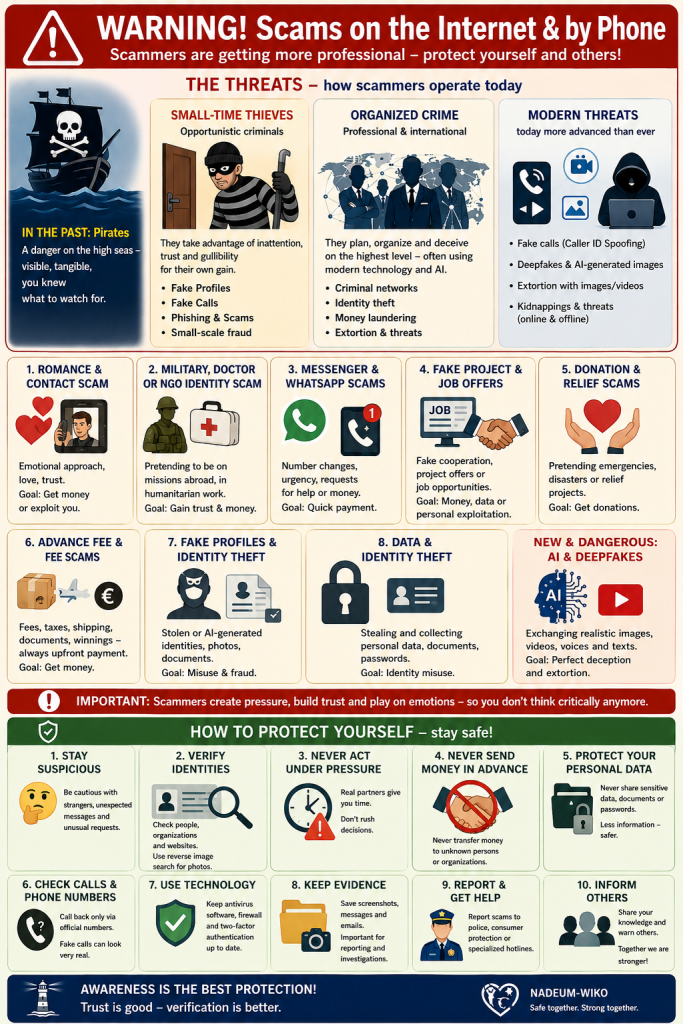
International exchanges also involve risks arising from inappropriate online contact and attempts at fraud.
NADEUM-WIKO provides information on typical types of fraud, warning signs, and protective measures for members and partners.
⚠️ Warning about online fraud and contact scams
Online fraud occurs worldwide in various forms. Especially in the international arena, fraudsters often pose as military personnel, doctors, project staff, partner organizations, or private individuals. The goal is usually to build trust in order to later obtain money, data, or support.
NADEUM-WIKO provides information about typical forms of fraud so that members and interested parties can recognize risks early on and protect themselves.
Common types of fraud in the international environment
- Romance and contact scams
- Military, doctor, or NGO identity fraud
- Messenger and WhatsApp scams
- Project and job offers (fake)
- Donation and aid fraud
- Advance fee and fee fraud
- Fake profiles and identity theft
1️⃣ Romance and contact scam
Typical: emotional approach, relationship, trust
Context: social media, messenger
✔ AI-generated messages and deepfake video calls; perpetrators often spend weeks or months building trust before making a request.
2️⃣ Military, medical, or NGO identity fraud
Typical: Foreign deployment, humanitarian mission
Context: International contacts
✔ Stolen identities of real soldiers, doctors, UN staff or aid workers; plus AI-generated ID documents and photos.
3️⃣ Messenger and WhatsApp scams
Typical: Number change, urgency
Context: Smartphone communication
✔ Perfectly worded messages generated by AI; voice messages or calls using a cloned voice; urgency and time pressure.
4️⃣ Project and job offers (fake)
Typical: Cooperation, project, work
Context: NGO and development work
✔ Fake NGOs, peace projects or development organisations; professional-looking websites and fake references; fraud in international cooperation.
5️⃣ Donation and aid fraud
Typical: Emergency situation, request for help
Context: Humanitarian issues
✔ Fake charity projects using stolen images; photos of real disasters or relief operations used without permission; fabricated success stories.
6️⃣ Advance fee and fee fraud
Typical: Package, travel, documents, fees
Context: International transfers
✔ Not only demands for money, but also requests to buy cryptocurrencies, provide access to bank accounts or forward parcels (financial agent fraud).
7️⃣ Fake profiles and identity theft
Typical: stolen photos, false identity
Context: social media
✔ AI-generated faces rather than just stolen photos; identity theft now also affects documents, videos and voices.
8️⃣ Data and identity theft
Many fraudsters are not initially after any money at all, but rather information.
Examples:
Copies of passports
Identity documents
Bank details
Club documents
Signatures
Login details
Telephone numbers
This data is later used to commit further criminal offences.
9️⃣ Safely verifying international contacts
This isn’t actually a type of fraud, but rather a safety guide.
For example:
How to protect yourself
Verify their identity independently.
Arrange a video call.
Check the profile picture using a reverse image search.
Contact the organisation officially.
Check the domain and legal notice.
Do not make any advance payments.
Do not send any confidential documents.
Be particularly careful when under time pressure.
Reputable organisations accept security checks.
Honest partners understand that identities, projects and documents are subject to verification. Transparency, mutual trust and verifiable information are essential foundations for successful international cooperation.