WWF23 Wasini Waste-Free23
Table of Contents
WWF23 -Wasini Waste Free23 (SHG)
Introductory text – WWF23 (WasiniWasteFree23)
WasiniWasteFree23 was founded by Mr Bilali Abdalla Bilali – driven by the need to protect one of East Africa’s most valuable yet vulnerable coastal regions.
In the very south of Kenya, in the Indian Ocean, lies Wasini Island – a small island of extraordinary natural beauty. Its coral reefs, mangrove forests and fishing grounds make it unique and a popular destination for tourists from all over the world. Yet it is precisely this beauty that is increasingly under threat.
Africa’s coasts are suffering massively from the flood of plastic waste. Waste from global consumption, international shipping, tourism and a lack of local waste infrastructure enters the sea unchecked and washes up on the beaches. Neither at regional nor at global level do sufficiently effective political measures, consistent environmental laws or functioning waste collection and recycling systems currently exist to put a sustainable stop to this problem.
At the same time, with a population of nearly nine billion people, the world today operates within a consumer system that still functions as if resources were unlimited and waste had no consequences. This assumption is long outdated. Nature can no longer absorb the amount of plastic we produce and carelessly dispose of. The consequences are already evident today – and they will continue to worsen if we do not act.
On Wasini Island, these effects are immediately apparent:
The mangrove forests, which serve as natural protective barriers, nurseries for fish and significant CO₂ sinks, are being damaged by plastic waste. Fish and marine organisms ingest microplastics, their populations are declining – and with them the livelihoods of the local population. Ultimately, humans themselves suffer: in terms of health, the economy and society.
Yet on Wasini Island, a shift in thinking is beginning. People are realising that protecting their environment is synonymous with protecting their own future. WasiniWasteFree23 is an expression of this awareness: a local initiative, supported by the community, with the aim of collecting, sorting and recycling plastic waste, raising awareness and developing long-term sustainable solutions – for the island, for the sea and for future generations.
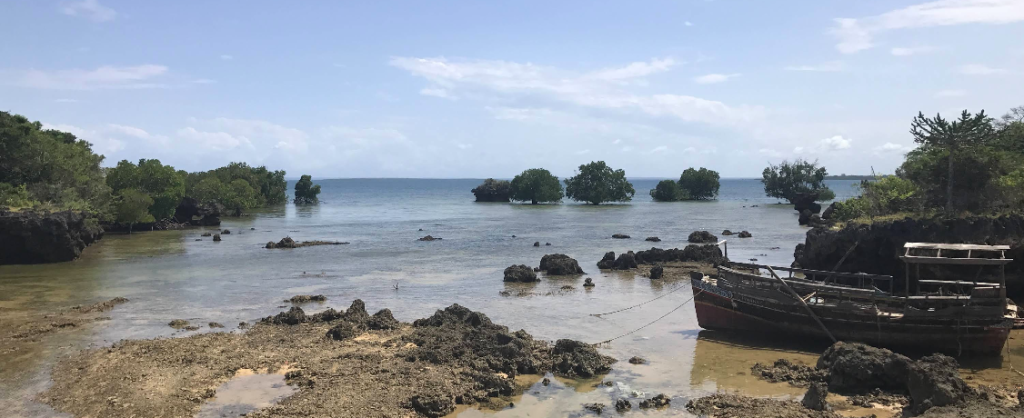
A Brief Historical Overview of Wasini Island – ‘Waschina’ or ‘Chinese’
There are three villages on Wasini Island: the main village is called ‘Wasini’, the second ‘Mkwiro’ and the third ‘Behind the Water Village’. I, Bilali Abdalla, live in the main village of Wasini Island, near the ‘Mgodo Mosque’.
The island itself is 7 km long and 4 km wide and has more than 4,000 inhabitants. In fact, Wasini Island means “Waschina” or “Chinese” – they were the first visitors to arrive to trade in cowrie shells, from which everyday items such as cups, plates, etc. were made. There are now only a few descendants of the Chinese left on Wasini Island; the population consists mainly of Arabs and the “Vumba” people.
Unlike the Chinese, the Arabs stayed on Wasini Island for a long time. The Arabs went on to form a relationship with the local Bantu, a large community in Kenya, and established a local tribe known as the Vumba. The people there are black Arabs.
- The second visitors were the Arabs, who arrived between the 18th and 19th centuries for the slave trade. Three kilometres off Wasini Island lies the mainland known as Shimoni, a local Swahili word meaning ‘caves’ or ‘holes’, where the slaves were held for about two to three weeks before being transported to the notorious market in Zanzibar and on to overseas destinations – Iran, Iraq and so on, mostly Arab countries.
- The boats used to transport the slaves were called Arab dhows. The journey by dhow from Wasini Island to Zanzibar – Tanzania is actually Austria’s neighbouring country.
- However, the slave trade was abolished, and Shimoni developed into a major fish market, whilst Wasini Island became a hub for tourist attractions.
The large fish market in Shimoni.
Here on Wasini Island, tourism is the most important economic sector, followed by fishing. The men go out in boats to fish, using various methods, whether with open basket traps, lines, nets or by local diving. They fish both during the day and at night.
At low tide, the women search for squid and shellfish using pointed sticks. Other women work in restaurants, cooking local Swahili dishes such as coconut rice, coconut sauce, cassava, chapati, etc. Still others fry fish and sell it, or both women and men sell raw fish at the large fish market in Shimoni.