No. 01 – LYF Responsibility*

Table of contents
The ‘6 + 6 NATURAL LAWS for your personal goal’ at a glance
This is your first exercise.
Please read it carefully.
If you have any questions, please contact your coach on WhatsApp: +43 (0) 660 7621873
No. 01 – Light your Fire of Responsibility –
Taking responsibility means seizing a great opportunity. And without taking responsibility in society, there can be no successful engagement in society. By practising consciously taking responsibility for my own thinking, I recognise the creative possibilities in my own sphere and gain personal freedom.
§ 1 – Responsibility [33 exercise pages in total (23 – 56)]
[Page 23]1 RESPONSIBILITY
Responsibility is the fundamental basis of social competence.
Responsibility arises from our level of knowledge.
Accordingly, it is essential that we acquire knowledge and understanding in order to be able to take responsibility for ourselves and others.
In the company, we are held accountable in accordance with our general education and in relation to internal training courses.
In this context, learning means that we can be called upon to take on more and more responsibility in the company in the course of our vocational training and education.
Youth coaching also imparts knowledge in the area of social skills and principles of success, which enable us to get along better with ourselves and our environment, to be more successful and to have a repertoire of possibilities – ‘tools’ – at our disposal that enable us to act and govern optimally and also to drive forward developments in the company in an innovative and proactive manner.
We gain knowledge that enables us to take responsibility for ourselves in terms of our personal accountability, to take responsibility in operational matters and to realise development opportunities for ourselves and for the company.
The basic principle is:
Self-determination in our thinking
We choose our own path and follow it ourselves.
[Page 23]

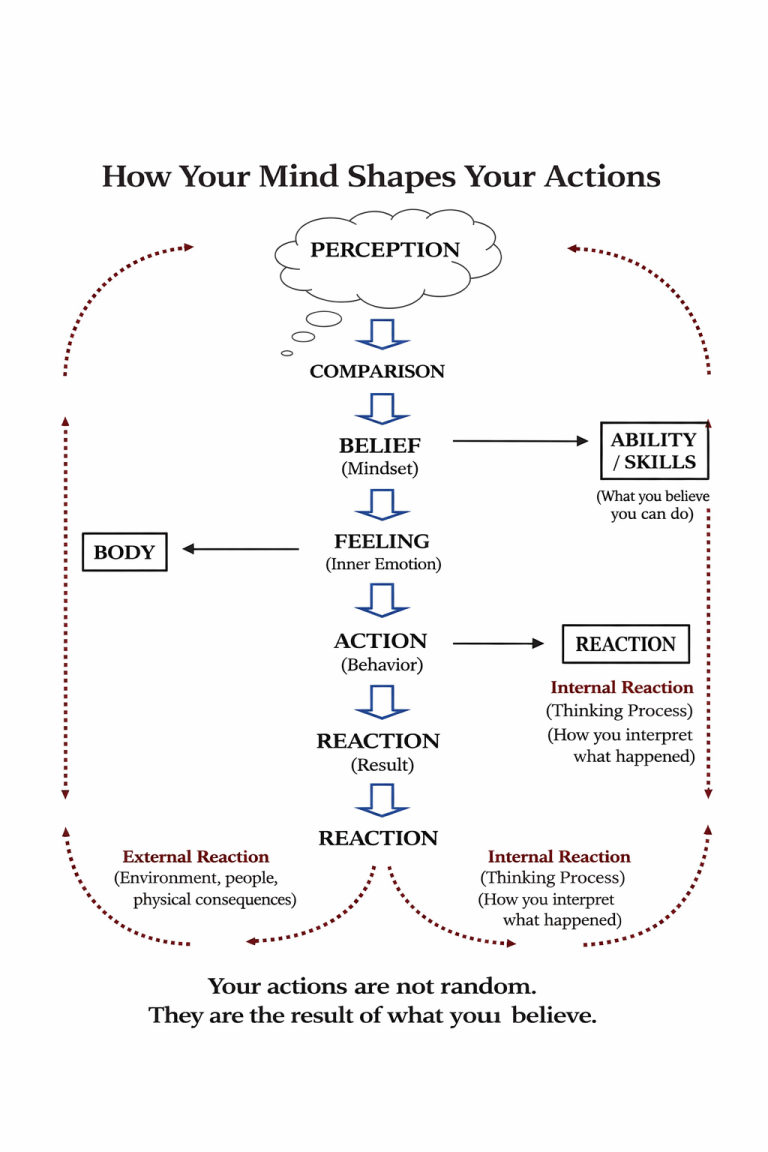
[Pages 25–26]
Thought process or control model:
In this model, we understand the ‘thought process’ to be the perception and processing of this perception by comparing it with existing patterns or conditioning stored by us, known as beliefs.
Through coaching, we acquire new behaviours based on new insights that have been consolidated and trained through exercises.
Explanation of the individual steps of the thought process or self-control:
1. Perception:
Perception means, above all, looking at everything very closely, taking your time, picking up on the ‘signals’ that people emit while they are speaking, drawing our own conclusions from them and incorporating these into the thought process.
Perception can be visual, auditory, emotional, intuitive or haptic.
2. Comparison
By comparison, we mean the processing of our perception with existing patterns or conditioning that we have stored.
3. Situational belief – opinion
The process of comparison gives rise to what is known as a situational belief. Based on our previous experiences, we tend to select those beliefs that we are used to, or that we have been taught or have taught ourselves. We must critically question the results of this choice – have we actually achieved our goals or operational goals?
Through coaching, we acquire new behaviours based on new insights that have been consolidated and trained through exercises. If we now apply these new beliefs, we will achieve increasingly better results and receive desirable feedback.
[Page 25]
4. Feeling
After selecting what we believe to be the best belief, or after completing coaching and consciously choosing the optimal option, a feeling arises. We must now carefully examine this feeling to determine whether we find it beneficial or not. Only when we are truly certain that this feeling can be accepted by us, and that it will lead to a successful outcome for all involved, do we consciously decide on the next course of action.
5. Action
The action we now take, based on our perception, the comparison with beliefs, the selection of the appropriate belief and our ‘optimal’ feeling, is confident, i.e. completely self-determined and freely chosen.
6. Reaction
After the action has been taken, two types of reactions occur – an internal reaction, i.e. my own reaction to my action, and an external reaction, i.e. that of my environment.
My internal reaction now influences my future thought process by incorporating the optimal results achieved into my future choice of beliefs. I feel encouraged in my abilities.
The external reaction, that of my environment, has an effect on my emotional level. The optimal result gives me positive feedback, which makes me feel very good and reinforces my future choice of beliefs. My environment gives me certainty about my abilities.
7. Result
By training and applying this model of the thought process, we are able to control ourselves. The coaching programme teaches us approaches for selecting new beliefs and redefining our strategies for action.
We enjoy a new kind of freedom – that of leading or controlling ourselves, of being the ‘captain’ and steering our ship from our own ‘bridge’. We gain new control over ourselves.
[Page 26]
[Page 27]
Summary:
- Positive beliefs support my abilities and skills
- Appropriate new beliefs increase my chances of achieving my goals in the best possible way
- New positive beliefs lead to a good, better feeling
- Old negative beliefs result in bad feelings and lead to dangerous insecurities
- Positive beliefs enable me to optimally control my physical and mental well-being and trigger positive reactions in my environment.
Coaching strategy:
Changing beliefs
- Recognising existing beliefs
- Recognising the effects of existing beliefs
- Assessing the effects: positive/negative
- Decision to change beliefs
- Definition of the desired effects
- Definition of the new, desired beliefs
- Application of the insights gained from the youth coaching programme
[Page 27]
[Page 28]
Training our unconscious/subconscious
By practising the exercises in the coaching programme, we train our unconscious/subconscious to impart those beliefs that lead to optimal results for us and our environment.
Let’s compare our unconscious/subconscious mind to a 300 hp outboard motor on a boat. Whether we want it to or not, it runs at full speed all the time and drives the boat in every conceivable direction, towards cliffs and rock faces.
If we now symbolically take the helm of our 300 hp outboard motor on the boat ourselves – equivalent to applying the thinking model or control model – then we determine the direction of the boat ourselves and can elegantly avoid obstacles and enjoy the fast ride to the fullest.
It is essential to know that the unconscious/subconscious reacts particularly strongly to images and feelings. Impressions that we gain visually or through experience are firmly anchored in the unconscious, i.e. permanently stored and thus guide our actions insofar as they strongly influence our beliefs. Through targeted coaching and exercises during the training period – and subsequently as part of our independent personal development – we comb through our subconscious and anchor completely new, constructive and positive images and feelings that open up entirely new perspectives for action, generate new positive feelings and lead us to optimal results for ourselves and in relation to our environment.
In order to sharpen our awareness of the power of our unconscious/subconscious, it is necessary to realise that the unconscious accepts only images and feelings as sources of information and is 100% committed to realising these images and feelings. It is therefore extremely important to pay close attention to what we expose our subconscious to. The coaching programme provides us with a completely new approach to dealing with beneficial/harmful influences (1) of a material nature – such as nutrition, drugs – as well as on the (2) level of information – (3) media, internet – and through frequencies – music, noise, low-frequency sound waves.
[Page 28]
[Page 29]
Benefits of applying social competence and responsibility:
- Our ability to control ourselves
- Our ability to programme ourselves
- My freedom to think what I want
- The controllability of my feelings
- Awareness through recognising and manifesting my own thought patterns
- A better quality of life through constructive thinking
- Increased control
- Increased authenticity through greater success, satisfaction and recognition from my environment
- The realisation that I can programme my unconscious/subconscious mind through images – visual information – and through feelings, and thus achieve a lasting effect in the desired direction.
[Page 29]
[Page 30]
Attendance unit 1 / Workshop 1:
Initial test of social competence:
| Lfd. Nr.: | Text | ‘1’ I very much agree | ‘2’ I agree | ‘3’ I disagree | ‘4’ I completely disagree |
|---|
- I get along well with my fellow human beings.
> - My motto is ‘Those who don’t give up can lose, those who give up have already lost.’
> - I like to approach people and make new contacts easily.
> - I see little opportunity to improve my current situation.
> - I often get annoyed with other people.
> - I frequently feel exhausted and powerless.
> - I like to laugh a lot.
> - The fact that I often seek confrontation proves that I can assert myself and make my mark.
> - Everything often becomes too much for me, but there’s nothing I can do about it.
> - I have goals in mind and am working towards them.
> - I feel respected by those around me.
> - The best way to succeed is to radically abandon my ‘bad habits’ overnight.
> - I know what I want in life.
> - People can rely on me.
> - People can rely on me.
> - I would like to change some things in my life, but circumstances prevent me from doing so.
> - I know my strengths and weaknesses.
> - It is easy for me to get other people excited about something.
> - I know who I am and what I can do.
> - I often ask myself what my purpose in life is.
> - When there are differences of opinion, I immediately counter with counterattacks so that the other person doesn’t dare say anything else against me.
> - When I talk to people, I inconspicuously adapt my language, gestures and facial expressions to them.
> - It’s better to be suspicious than to be deceived or taken advantage of.
> - Even leaders should not always remain in their role. As a leader, I need to let myself go from time to time and act as if I were not a leader.
>
[Page 31]
Attendance unit 1 / Workshop 1:
Objective:
- The first workshop aims to teach participants the basics of self-management. Participants must be ‘won over’ to the coaching programme and motivated to approach youth training with enthusiasm.
- The first half of the workshop is intended to spark interest and enthusiasm.
- In the second half, the topic of Adler’s control model and self-programming (1st responsibility) will be addressed directly.
Documents:
- Skill.Card
- Initial social skills test
- Info e-Coaching
- Teaching materials
- Reminder card ‘
Not’ - Workshop 1 content sheet
Setting:
Circle of chairs, flip chart, laptop + projector
Initial social skills test:
- Explain the initial social skills test and then hand out the questionnaire.
- A personality analysis is carried out at the first and last workshops so that the development of each individual can be measured.
- Have the initial social skills test completed and collected.
[Page 31]
[Page 32]
Social skills:
What are social skills?
Common opinion: good behaviour, politeness, punctuality.
Although these are part of it, they are not what we do in the course.
At LYF!, we do much more.
We understand social skills to be the ability to cope with oneself and one’s environment.
Who is completely satisfied with themselves?
Statements such as ‘That’s just the way I am’ are just excuses to avoid having to deal with yourself.
- A) What could you improve about yourself? Attitude, reliability, charisma, self-discipline, etc.? Brainstorming – flip chart.
- B) What do you want to get/achieve/be? Brainstorming – flip chart.
- C) Do you need A) to get B)? YES! Are you ready to seriously work on A)? YES!
Self-control:
Our subconscious perceives ‘signals’ from the other person – gestures, facial expressions, posture and charisma, etc.
These signals determine whether I find someone likeable, whether I trust them, or whether I can stand them or not.
Can I control my signals?
Only through the ability to consciously control and programme my thinking or thought processes in accordance with the control model described above, based on socially competent upbringing and/or professional coaching/self-training – personality development – can my personality send out the signals I want it to.
Authenticity is an essential quality here!
Self-control begins with self-awareness. It takes a great deal of courage, strength and character to look at oneself objectively – what am I really like?
Every person has potential for improvement. This is not about judging whether something is ‘bad’, but about the willingness to develop oneself and to ignite one’s perhaps hidden strengths or one’s entire potential!
Of course, it is easier to play it cool and casual. This means that I no longer have to deal with myself and my affairs.
Now that I know where I stand, I can start with self-control. And then with external control. Only when I have mastered self-control can I acquire the ability to control others.
[Page 32]
[Page 33]
Examples of self-programming:
(1) List: Newspaper, analysis of ratio of positive to negative news
Result: Decision – self-programming
(2) List: People – positive/negative aura
Result: Decision – self-programming
(3) Write down 3 positive events per day/at work
Exercise: 30 days
Result: Decision – self-programming
(4) Delete ‘NOT’! (Reminder card: NOT / HOW)
Exercise: 14 days NOT delete without replacement
(5) Inner/outer attitude
Exercise 1: Head down – ‘nice day!’
Head up – ‘bad day!’
Exercise 2: 14 days Attitude! Smile!
Benefit from applying Adler’s thinking model / control model:
- Feedback from participants
- Feedback on exercises
[Page 33]


Beide Grafiken sind von Mag. Andreas G. Andiel 2023 im Zuge seiner “Light Your Fire” Coaching Mappe erstellt worden
[Seiten 34-35]
[Page 36]
LYF Training Day 1:
- Success Principle I.1. – Take 100% Responsibility for Your Life
- PowerPoint Presentation I. The Fundamentals of Success → Presentation I. (Download) p.1-5
- Exercise ‘Responsibility’ Day 1: Sharpen your perception / ‘Detective’
Observe all the people around you for one day.
- What activities are these people involved in?
- What activities are required of me or do I set myself?
- What reactions do I observe between these people and what reactions do I elicit in relation to these people?
In the evening, write down your observations:
Who was responsible for what?
- Who actually lived up to their responsibility?
- Who programmed their subconscious with which images or feelings?
- Which situations have been anchored in the subconscious of the people observed as ‘images’ or ‘feelings’? Which “moods” have a lasting effect on the people observed?
Which images or feelings did I ‘take with me’?
- Are these beneficial or detrimental to the programming of my subconscious?
- What influence did I have on the events I observed?
- Could I have developed other options to influence the events constructively?
- What responsibilities were assigned to me?
- What was I actually responsible for?
[Page 36]
[Pages 37–39]
Slide 1:
The Success Principles
- How to get from where you are now to where you want to be
- With reference to the book
- The Success Principles – How to get from where you are now to where you want to be
- [2005] Jack Canfield and Janet Switzer
- www.thesuccessprinciples.com
J. Canfield 2005: The Success Principles
Slide 2:
PART ONE
The Fundamentals of Success
- Learn the fundamentals of the game and stick to them.
- Quick fixes never last.
- Jack Nicklaus, legendary professional golfer
- Life is like a combination lock;
- your job is to find the right numbers in the right order
- so that you can achieve everything you want.
Brian Tracy
J. Canfield 2005: The Success Principles
Slide 3:
Principle 1
Take 100% responsibility for your life
- ▪ If you want to be successful, you must take 100% responsibility for everything you experience in your life.
- ▪ This includes:
- ▪ The level of your achievements
- ▪ The results you achieve
- ▪ The quality of your relationships
- ▪ The state of your health and physical fitness
- ▪ Your income / your debts
- ▪ Your feelings / everything
J. Canfield 2005: The Success Principles
Slide 4:
Principle 1
Take 100% responsibility for your life
▪ You must give up all your excuses.
- ▪ E + R = O (Event + Reaction = Outcome)
- ▪ You can change your reactions (R) to events (E) – the way things are – until you achieve the outcome (O) you want.
- ▪ Everything you experience today is the result of decisions you made in the past.
J. Canfield 2005: The Success Principles
Slide 5:
Principle 1
Take 100% responsibility for your life
- ▪ You must stop complaining!
- ▪ The circumstances you complain about are, by their very nature, situations you can change – but you have decided not to change them.
- ▪ You need a reference point of something you prefer, but for which you do not want to take responsibility.
- ▪ But why don’t you just do these things?
Because they involve risks.
J. Canfield 2005: The Success Principles
[Pages 37 – 39]
[Page 40]
LYF Training Day 1 – Exercise Reference
- Success Principle I.1. – Take 100% responsibility for your life
- PowerPoint Presentation I. The Fundamentals of Success → Presentation I. (Download) pp. 1–5
- Personal Area of My Life – Sharpen Your Perception
| E + (life event) | R (previous answer) | = O (previous outcome) | Need for change according to my 100% responsibility |
|---|---|---|---|
- First field: (fill this in according to the specified headers)
- >
- Second field: (fill this in according to the specified headers)
- >
- Third field: (fill this in according to the specified headers)
- >
- Fourth field: (fill this in according to the specified headers)
- >
| E + (life event) | R (new response) | = O (desired outcome) | Evaluation of the new result |
|---|
- First field: (fill this in according to the specified headers)
- >
- Second field: (fill this in according to the specified headers)
- >
- Third field: (fill this in according to the specified headers)
- >
- Fourth field: (fill this in according to the specified headers)
- >
[Page 41]
LYF Training Day 2:
- Success Principle I.1. – Take 100% responsibility for your life
- PowerPoint Presentation I. The Fundamentals of Success → Presentation I. (Download) pp. 1–5
- LYF Training Day 2 – Exercise Reference
- Professional area of my life – Sharpening perception
| E + (life event) | E + (life event) | = O (previous result) | Need for change according to my 100% responsibility |
|---|
- First field: (fill this in according to the specified headers)
- >
- Second field: (fill this in according to the specified headers)
- >
- Third field: (fill this in according to the specified headers)
- >
- Fourth field: (fill this in according to the specified headers)
- >
| E + (life event) | R (new reply) | = O (Desired result) | Evaluation of the new result |
|---|
- First field: (fill this in according to the specified headers)
- >
- Second field: (fill this in according to the specified headers)
- >
- Third field: (fill this in according to the specified headers)
- >
- Fourth field: (fill this in according to the specified headers)
- >
[Page 41]
[Page 42] LYF Training Days 3+4:
Success Principle I.4. – Believe that it is possible, I.5. Believe in yourself
PowerPoint Presentation I. The Fundamentals of Success → Presentation I. (Download) pp. 10–11
Exercise ‘Responsibility’: Self-reflection
Self-reflection on old patterns versus new behaviours and taking responsibility for them:
- What results have I achieved with my previous influences/old patterns, and am I only partially successful with them?
- What is my personal responsibility in developing new behaviours in order to achieve optimal results?
- List specific examples of cases in which you hold yourself accountable for your responsibility – in the following fundamental areas of life:
- The financial areas of my life
- My work and my future career
- My free time, my time to relax
- My body, my physical and mental health – sport and education
- My relationships with family, friends, acquaintances and work colleagues
- My personal development through further education, training, therapy, spiritual pursuits, music, literature, art, travel
- My involvement in social issues, charity work
Ongoing coaching exercises:
- 2 litres of water per day – 7.5 hours of sleep per night
- Media hygiene: selection of high-quality media, print sector, internet
[Page 42]
[Page 43]
LYF Training Day 3 – Exercise Reference
- Principle of Success I.4. – Believe that it is possible, I.5. Believe in yourself
- PowerPoint Presentation I. The Fundamentals of Success → Presentation I. (Download) pp. 10–11
- Exercise ‘Responsibility’: Self-reflection
| area of life | Old patterns of behaviour: suboptimal results to date | Developing new behaviours: responsibility for new, optimal results |
|---|
- Finances
> - Work – professional career
> - Leisure, recreation
> - a) Body – sport, physical health
> - b) Mental health – education
>
[Page 44]
LYF Training Day 4 – Exercise Reference
- Success Principle I.4. – Believe that it is possible, I.5. Believe in yourself
- PowerPoint Presentation I. The Fundamentals of Success → Presentation I. (Download) pp. 10–11
- Exercise ‘Responsibility’: Self-reflection
| area of life | Old patterns of behaviour: suboptimal results to date | Developing new behaviours: responsibility for new, optimal results |
|---|
- (5.) Family, friends, acquaintances, work colleagues
> - (6.) Personal development Further education, training, therapy, spirituality, music, literature, art, travel
> - (7.) Society, charity
> - (8.) Open category
> - (9.) Open category
>
Ongoing coaching exercises:- 2 litres of water per day – 7.5 hours of sleep per night
- Media hygiene: selection of high-quality media, print sector, internet
[Page 44]
- (5.) Family, friends, acquaintances, work colleagues
[Page 45]
LYF Training Day 5:
- Success Principle I.6. – Become an inverse paranoid
- PowerPoint presentation I. The basics of success → Presentation I. (Download) p. 12
- Exercise ‘Responsibility’:
Assessing and recognising the effects of my behaviour
(1) Approach people today in an authentically positive manner – friendly and cheerful – and consciously observe their reactions!
Assessing and recognising the effects of my behaviour
(2) Consciously decide to adopt a positive attitude towards a person of your choice – think about how nice, friendly, intelligent and likeable they are. Approach this person and recognise how your thinking affects them!
Ongoing coaching exercises:
- 2 litres of water per day – 7.5 hours of sleep per night
- Media hygiene: selection of high-quality media, print sector, internet
DO NOTdelete without replacement – Day 1 of 14
[Page 45]
[Page 46]
LYF Training Day 5 – Exercise Reference
- Success Principle I.6. – Become an inverse paranoid
- PowerPoint Presentation I. The Fundamentals of Success → Presentation I. (Download) p. 12
- Exercise ‘Responsibility’:
Evaluating and recognising the effects of my behaviour
| (1) Approach people with genuine positivity today – | friendly and cheerful – | and consciously observe the reactions to it! |
|---|
- Write down your consciously perceived reactions:
- >
- >
| (2) Make a conscious decision to adopt a positive attitude towards a person of your choice – | think how nice, friendly, clever and likeable he/she is. | Approach this person and realise how your thinking affects them! |
|---|
- Write down your consciously perceived reactions:
- >
- >
[Page 47]
LYF Training Day 6:
- Success Principle V. 57.6. – You get what you focus on
- The Quadrants of Empowered Wealth
- PowerPoint Presentation V. Success and Money → Presentation V. (Download) p. 15
- Exercise ‘Responsibility’:
Belief Change – 30 Days: – Day 1 of 30
Which 3 events on this day impressed you, did you particularly enjoy?
- What did you notice that was positive about yourself and others today?
- Did you encounter any role models today? What impressed you most about them?
- What did you do particularly well at work today?
- Did you exceed expectations and receive special recognition?
- Did you receive exceptionally good feedback from colleagues regarding your personal and/or professional performance?
Ongoing coaching exercises:
- 2 litres of water per day – 7.5 hours of sleep per night
- Media hygiene: selection of high-quality media, print sector, internet
DO NOT
delete without replacement – Day 2 of 14
[Page 47]
[Page 48]
LYF Training Day 6 – Exercise Reference
- Success Principle V. 57.6. – You get what you focus on
- The Quadrants of Empowered Wealth
- PowerPoint Presentation V. Success and Money → Presentation V. (Download) p. 15
- Exercise ‘Responsibility’:
Belief Change – 30 Days – Day 1 of 30
Write down:
- Today, I noticed the following particularly positive things about myself and others:…
- I encountered the following role model today and was particularly impressed by:…
- At my workplace today, I succeeded optimally in the following:…> I delivered the following work beyond expectations and received special recognition:…> I received exceptionally good feedback from the following colleagues regarding my personal and/or professional “performance”:
[Page 48]
[Page 49]
LYF Training Day 7:
- Success Principle V. 57.6. – You get what you focus on
- The Quadrants of Empowered Wealth
- PowerPoint Presentation V. Success and Money → Presentation V. (Download) p. 15
- Exercise ‘Responsibility’:
Sharpening the perception of new beliefs – perception of one’s own body
(1) Healthy eating is the basis of our long-term well-being.
Let’s make conscious decisions about which foods fall into this category and also taste good to us.
(2) Physical activity is the best prerequisite for our long-term fitness and health.
Let’s make conscious decisions about which sports we enjoy in the long term.
(3) Let’s make conscious decisions to walk certain distances, climb stairs and sometimes sprint!
Let’s pay attention to our bodies – to our posture and any pain we may feel.
(4) Stand naked in front of a mirror and look at yourself. Consciously notice what you particularly like about yourself and what you would like to change.
Make your own conscious decisions about what you want to change about your body!
Ongoing coaching exercises:
- 2 litres of water per day – 7.5 hours of sleep per night
- Media hygiene: selection of high-quality media, print sector, internet
DO NOTdelete without replacement – Day 3 of 14
- 3 TOP Experiences of the day – Day 2 of 30 ( LYF! Coaching Manual pp. 39-40)
[Page 49]
[Page 50]
LYF Training Day 7 – Exercise Reference
- Success Principle V. 57.6. – You get what you focus on – The quadrants of empowered wealth
- PowerPoint presentation V. Success and money → Presentation V. (download) p. 15
- Exercise ‘Responsibility’: Belief Changes Body – 30 Days – Day 1 of 30
(1) Healthy eating is the foundation of our long-term well-being. Let’s make conscious decisions about which foods fall into this category and also taste good to us.
> Write down the relevant foods:
(2) Physical activity is the best prerequisite for our long-term fitness and health. Let’s make conscious decisions about which sports we enjoy in the long term.
> Write down the sports you would like to start doing right away:
(3) Let’s make conscious decisions to walk certain distances, climb stairs and sometimes even sprint! Let’s pay attention to our bodies – our posture and any pain we may feel.
> Write down whether you have decided to walk, sprint and climb stairs in the long term:
(4) Stand naked in front of a mirror and look at yourself. Consciously notice what you particularly like about yourself and what you would like to change. Make your own conscious decisions about what you want to change about your body!
> Write down everything you like about your body:…
> Write down everything you would like to change about your body:
[Page 50]
[Page 51]
LYF Training Day 8:
- Success Principle V. 57.6. – You get what you focus on
- The Quadrants of Empowered Wealth
- PowerPoint Presentation V. Success and Money → Presentation V. (Download) p. 15
- Exercise ‘Responsibility’:
Sharpening your perception of new beliefs –
Recognising existing beliefs
Each of our actions triggers reactions and sets processes in motion with all the resulting consequences. Thus, we are responsible for this solely through our thoughts and beliefs. Depending on how strong our personal responsibility is, we influence ourselves or accept influences from our environment. In the coaching process, we sharpen our awareness of this and recognise existing beliefs as our own or those of others, and train ourselves in new beliefs that are more conducive to our goals.
You alone consciously decide on your thoughts and thus on your energies and the actions and processes that you trigger with them. This means that you alone are responsible for all those areas that are based on your thoughts, beliefs and attitudes.
Ongoing coaching exercises:
- 2 litres of water per day – 7.5 hours of sleep per night
- Media hygiene: selection of high-quality media, print sector, internet
DO NOTdelete without replacement – Day 4 of 14- 3 TOP Experiences of the day – Day 3 of 30 (LYF! Coaching Manual pp. 39-40)
- Belief changes Body – 30 days – Day 2 of 30 (LYF! pp. 41-42)
[Page 51]
[Page 52] LYF Training Day 8 – Exercise Reference
- Success Principle V. 57.6. – You get what you focus on – The quadrants of empowered wealth
- PowerPoint Presentation V. Success and Money → Presentation V. (Download) p. 15
- Sharpening your perception of new beliefs –
- Recognising existing beliefs
Write down difficult/challenging situations you face.
Which components of these situations are controlled by you?
Which components of these situations are controlled by others?
Who controls these aspects?
How can you act now?
How important would it be for you to control the situation?
What can you do to control this situation yourself?
What would you do if you could control this situation yourself?
[Page 52]
[Page 53]
LYF Training Day 9:
- Success Principle V. 57.6. – You get what you focus on
- The Quadrants of Empowered Wealth
- PowerPoint Presentation V. Success and Money → Presentation V. (Download) p. 15
- Exercise ‘Responsibility’:
Sharpening the perception of new beliefs
Recognising and evaluating the new beliefs
The Empowered Wealth Quadrants is our reference for examining where we currently stand and visualising where we want to go.
In each sector or quadrant and for each “asset”, we make our free will decision according to our self-directed thought process and on the basis of taking full responsibility for ourselves.
Today, we examine which new challenges we want to take on.
As a general rule, we delete the word “must” and replace it with “may”!
Ongoing coaching exercises:
- 2 litres of water per day – 7.5 hours of sleep per night
- Media hygiene: selection of high-quality media, print sector, internet
DO NOT
delete without replacement – Day 5 of 14- 3 TOP Experience of the day – Day 4 of 30 (LYF! Coaching Manual pp. 39-40)
- Belief changes Body – 30 days – Day 3 of 30 (LYF! pp. 41-42)
[Page 53]
Dear Andreas and Light Your Fire participants:
From here on, I still need to translate the text into English.
Thank you for your patience
[Page 54]
LYF Training Day 9 – Exercise Reference
- Success Principle V. 57.6. – You get what you focus on – The quadrants of empowered wealth
- PowerPoint presentation V. Success and money → Presentation V. (download) p. 15
- Sharpening your perception of new beliefs –
- Recognising and evaluating new beliefs
For the “assets” you have selected, please note down which goals you would like to achieve in the future, which you are allowed to achieve – if you allow yourself to do so:
Which goals that you learned about in exercises 1-8 would you still like to integrate into your personality or require more intensive attention – need to be trained even more
Which goals have you already achieved or which exercises have already produced significant results? What conclusions or lessons could you draw from this? What was particularly helpful?
[Page 54]
[Page 55]
LYF Training Day 10:
Overview of Exercises 1-9 ‘Responsibility’:
Anchoring new beliefs
Exercise 1: Sharpening perception / “Detective”
- Exercise 2: Sharpening perception / ‘Detective’
- Exercise 3: Self-reflection – Areas of life 1-4
- Exercise 4: Self-reflection – Areas of life 5-7
- Exercise 5: Evaluating and recognising the effects of my behaviour
- Exercise 6: Changing beliefs – 3 TOP events/experiences from the current day
- Exercise 7: Sharpening awareness of new beliefs – Awareness of one’s own body
- Exercise 8: Sharpening perception of new beliefs – Recognising existing beliefs
- Exercise 9: Sharpening perception of new beliefs – Recognising and evaluating new beliefs
Ongoing coaching exercises:
- 2 litres of water per day – 7.5 hours of sleep per night
- Media hygiene: Selection of high-quality media, print sector, internet
DO NOT- delete without replacement – Day 6 of 14
- 3 TOP Experiences of the day – Day 5 of 30 (LYF! Coaching Manual pp. 39-40)
- Belief changes Body – 30 days – Day 4 of 30 (LYF! pp. 41-42)
[Page 55]
[Page 56]
LYF Training Day 10 – Exercise Reference
Overview of Exercises 1–9 ‘Responsibility’:
Anchoring new beliefs: Strategies
Please note down 1–3 strategies for achieving your goals in relation to developing and applying new beliefs for the topics covered in Exercises 1–9:
(1) Main strategy /
(2) Back-up strategy 1 /
(3) Back-up strategy 2
- Exercise 1: Sharpening perception / ‘Detective’
- Exercise 2: Sharpening perception / ‘Detective’
- Exercise 3: Self-reflection – Areas of life 1-4
- Exercise 4: Self-reflection – Areas of life 5-7
- Exercise 5: Evaluating and recognising the effects of my behaviour
- Exercise 6: Changing beliefs – 3 TOP events/experiences from the current day
- Exercise 7: Sharpening your perception of new beliefs – Perception of your own body
- Exercise 8: Sharpening your perception of new beliefs – Recognising existing beliefs
- Exercise 9: Sharpening awareness of new beliefs – recognising and evaluating new beliefs
[Page 56]

You have completed this exercise and consciously reflected on your thoughts and experiences. Take a moment to notice what you have realised or felt during this process.
Before moving on to the next task, you may want to retreat to a quiet place to gather your thoughts and continue with renewed clarity. Each exercise builds on the previous experiences and strengthens your personal development step by step.
Next step
Now move on to the next exercise and continue your training journey.
👉 Continue to: [No. 02 – Light your Fire of Learning –]

No. 02 – Light your Fire of Learning –
Learning from ‘mistakes’ means improving the path until it leads to the achievement of a goal. Get out of the ‘mistake game’!
The main topics in this unit are solution-oriented, constructive thinking and acting, positive interaction with your own environment, and accepting all feedback as an indicator for optimising your own path.
No. 03 – Light your fire of will –
The difference between dreams, desires and intentions. How to develop determined willpower. Recognise your own goals, develop a goal plan, determine the necessary effort and learn to develop a strong will for activities for yourself (and others) that makes achieving the goal possible in the first place.
No. 04 – Light your Fire of Action –
Knowing when to act, what to do and how to do it is the basis of any project. Once planning and decision-making are complete, it is now a matter of moving from words to deeds and focusing all energies on the start-up phase.
No. 05 – Light your Fire of Trust –
It is important to trust yourself. However, it is just as important that society/the environment builds trust in us! One of the most important prerequisites for this is reliability, which in turn is based on personal responsibility and time/self-management.
No. 06 – Light your fire of reality –
It is not always necessary to see everything the way everyone else sees it. However, it is crucial to know how others focus on learning to deal with it and to achieve a more understanding approach to one’s environment. Empathy, understanding and tolerance are key skills for harmonious coexistence.
You have completed this exercise and consciously reflected on your thoughts and experiences. Take a moment to notice what you have realised or felt during this process.
Before moving on to the next task, you may want to retreat to a quiet place to gather your thoughts and continue with renewed clarity. Each exercise builds on the previous experiences and strengthens your personal development step by step.
Next step
Now move on to the next exercise and continue your training journey.
👉 Continue to: [No. 02 – Light your Fire of Adaptation –] _ (Please contact your coach/Light Your Fire trainer for more information)
No. 07 – Adaptation –
Everyone is primarily there for themselves. The closer you are to another person, the closer you are to them. And the more you get back. Conscious adaptation or non-adaptation must be used in combination with a responsible approach to one’s own environment. By consciously deciding to adapt or not to adapt, the individual gains personal freedom and strength.
No. 08 – Leadership –
The basics of ‘alpha leadership’ and how to apply it correctly. The right balance between ‘leading’ and ‘being led’. In this unit, it is also important to learn how to consciously use the tool of ‘being led’ and thus create valuable conditions for teamwork and/or team leadership.
No. 09 – Balance –
Recognising a balance between “giving” and ‘taking’. The balance of body, mind and soul must be established in order to maintain the same level of performance. It is also important to comply with compensation to third parties. ‘If you want to reap, you must first sow.’ Those who are aware that they must always pay for the desired person in the form of performance, resources, etc., will achieve their goals more easily and be appreciated by those around them for their efforts.
No. 10 – Growth –
Everything grows through a cycle of pushing forward and pausing. Those who handle this correctly will get the most out of it. Continuous action leads to growth and success. This unit conveys the positive aspects of consistent action, which is the basic prerequisite for success in any activity (private or professional).
No. 11 – Defence –
Knowing when, what and how to defend yourself successfully gives you the gentle calm of self-confidence. In a conflict situation, develop a ‘we’ mindset and work together to find solutions that everyone can support. This unit also teaches basic skills for harmonious interaction with your professional, family and social environment.
No. 12 – Usefulness –
When we give others what they want, they give us everything according to the value we create for them. Increasing value means getting more. Knowing your own value leads to a strong personality that can act calmly and reasonably in all situations and shape your own life.
You have completed this exercise and consciously reflected on your thoughts and experiences. Take a moment to notice what you have realised or felt during this process.
Before moving on to the next task, you may want to retreat to a quiet place to gather your thoughts and continue with renewed clarity. Each exercise builds on the previous experiences and strengthens your personal development step by step.
Next step
Now move on to the next exercise and continue your training journey.
👉 Continue to: [Discuss this with your coach]