Resettlement and humanitarian admission programmes.
Table of Contents
Brief information presented in graphic form
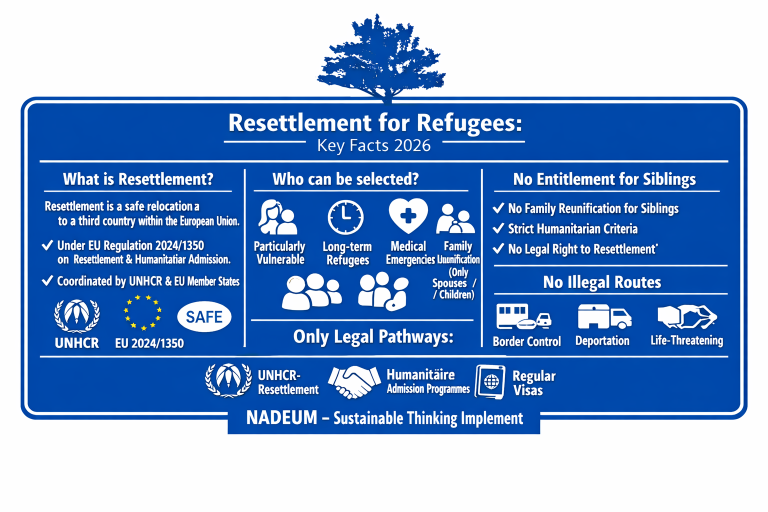
Accompanying Text for the English Graphic
Note on visual and textual representation

This infographic was created with the assistance of the AI system Microsoft Copilot. Its visual layout, icons, and structure were automatically generated to present complex information on Refugee Resettlement in a clear and accessible way. Because the system operates primarily in English, this version reflects the most accurate and linguistically consistent output. Minor deviations may occur in translations or localized adaptations.

Only the verified text approved by NADEUM‑WIKO is legally and editorially binding. The infographic serves as a visual aid for orientation and public communication but does not replace official or legally reviewed documents.

NADEUM – Sustainable Thinking Implement – Knowledge Communicate
🌍 INFORMATION FOR MIGRANTS AND REFUGEES
1. What is resettlement?
- Resettlement means that a refugee in particular need of protection is legally and safely relocated from a country of first asylum (e.g. Niger, Uganda, Kenya, Lebanon, Turkey) to a third country – for example, an EU country.
- Resettlement is not an immigration programme. It is a protection programme for the most vulnerable.
- The legal basis for this is EU Regulation 2024/1350 on resettlement and humanitarian admission (EUR-LEX – the official EU legal database).
2. Who is eligible for resettlement?
Selection is not made by the individual themselves, but by:
UNHCR, or an equivalent international organisation.
The following groups are eligible:
✔ People in particular need of protection
e.g. victims of violence, torture, persecution, single women, vulnerable families, people with disabilities.
✔ People who have been living as refugees for many years
and have no prospects in the country of first asylum.
✔ People with serious medical or mental health emergencies
where treatment is not available in the country of first asylum.
✔ Family reunification in the strict sense
Only spouses and minor children. Siblings, cousins, friends or adult children are excluded.
3. What is NOT possible
A lot of misinformation is circulating online and on social media. Here are the key clarifications:
✘ You cannot apply for resettlement yourself
There is no form, no ‘application’, no ‘list’.
✘ No legal entitlement – even if you are living in a camp
Even if you meet all the criteria, there is no legal entitlement.
✘ Siblings cannot be brought to Europe
This is clearly regulated under EU law and national law.
✘ Illegal routes are not a “Plan B”
They lead to:
- border procedures,
- deportations,
- years of uncertainty,
- and often to danger to life.
✘ Smugglers often make false promises
Many people die on the routes. Many are robbed, abused or exploited. Many who make it do not tell the whole truth.
4. What legal routes are available
✔ UNHCR resettlement
The most important and safest route.
✔ Humanitarian admission programmes
Some EU countries have their own programmes for people at particular risk.
✔ Regular visas
For work, study or family reunification (immediate family only).
5. Why the EU has tightened the rules
The EU faces major challenges:
- wars and crises around the world,
- high costs for social and asylum systems,
- irregular migration via people-smuggling networks,
- abuse of individual systems by individuals (not entire groups).
That is why new rules such as EU Regulation 2024/1350 have been introduced to:
- protect the most vulnerable,
- put a stop to people-smuggling networks,
- make illegal routes unattractive,
- define clear legal routes.
6. What migrants need to know
This section has been deliberately written in simple language so that it can be understood by everyone:
“Europe only accepts people whom the UNHCR classifies as being at particular risk. You cannot apply on your own initiative. Illegal routes are life-threatening and rarely lead to being granted residency. Only trust official authorities – not people smugglers or promises found online.”
7. Note to all readers
This information is taken from official EU legal sources (EUR-LEX) and UNHCR documents. It is intended to prevent false promises and dangerous misinformation. The decision on resettlement is made exclusively by the UNHCR or an equivalent organisation.
🌍 Official information on resettlement, legal routes and EU rules
To avoid false promises, dangerous misinformation and myths spread by people smugglers, we have provided official links here so that anyone can find out for themselves. All information is sourced from EUR-LEX (the EU legal database) and UNHCR, the organisations responsible for these matters worldwide.
EU legal basis (EUR-LEX)
- EU Regulation 2024/1350 – Resettlement & Humanitarian Admission
https://eur-lex.europa.eu/eli/reg/2024/1350/oj(eur-lex.europa.eu in Bing) - EU Pact on Asylum and Migration – Overview
https://commission.europa.eu/strategy-and-policy/priorities-2019-2024/promoting-our-european-way-life/new-pact-migration-and-asylum_en(commission.europa.eu in Bing)
UNHCR – Official information
- UNHCR Resettlement Programme
https://www.unhcr.org/resettlement(unhcr.org in Bing) - UNHCR Resettlement Handbook (Criteria & Procedures)
https://www.unhcr.org/resettlement-handbook(unhcr.org in Bing) - UNHCR Information Portal for Refugees (multilingual) https://help.unhcr.org/
Further official sources of information
- EUAA – Resettlement & Humanitarian Admission
https://euaa.europa.eu/asylum-resettlement(euaa.europa.eu in Bing) - EU Visas – Legal Entry Routes
https://europa.eu/youreurope/citizens/travel/entry-exit/index_en.htm(europa.eu in Bing) - UNHCR Austria – Help for Refugees and Asylum Seekers https://help.unhcr.org/austria/de/
These links enable anyone interested – whether from Africa, Europe or other regions – to find out for themselves how resettlement works, who is eligible and what legal routes are available. All information is official, verifiable and freely accessible.
AFRICA – UNHCR
- Ghana; Kenya; Nigeria; Rwanda
The Americas
- Brazil; Colombia; Canada; Mexico; USA
The Middle East and North Africa
- Egypt; Iraq; Jordan; Kuwait; Saudi Arabia; Syrian Arab Republic; Israel; Qatar; Lebanon