P015 AGENDA Quality of life 1150 WEST
Table of contents
2017 ‘How could ’NEU PENZING" become more future-oriented?
In 2017, as a retired former postal worker, I realised that my sub-district of Neu-Penzing had hardly changed for the better since 1986. The trees lining the streets were under considerable stress, and parked cars dominated the streetscape. I had moved here in 1986, full of hope and optimism. Today, this sub-district serves primarily as a residential and sleeping area. Many small businesses have disappeared or have had to close. All that remains is an animal feed factory, a piano manufacturer, a few schools, basement pubs and the usual consumer shops on the main streets.
On 1 May 2017, I retired after a long career. My professional life was characterised by a sense of duty, responsibility and close contact with the population.
Looking back, the job description of a delivery person has changed significantly over the decades. Between the late 1980s and the comprehensive restructuring, this job was not only logistical in nature, but also social: proximity to people, reliability and a relationship of trust with residents were key elements.
With the transformation of the former state-owned enterprise into a modern, economically successful company, tasks, priorities and framework conditions have changed fundamentally. New services, more efficient processes and other organisational requirements now characterise everyday working life. These developments reflect economic necessities and the changing times.
At the same time, the question arises as to how sustainable today’s working reality in the field is over an entire working life. The demands are high and the stresses are manifold – an experience that affects many areas of modern service work.
Since retiring, I have been looking at my immediate surroundings with new eyes. The western part of Vienna’s 15th district, once characterised by green spaces and recreational areas, now shows clear signs of increasing traffic congestion. Public space is being used more intensively, areas are changing their function, and the cityscape is adapting to new mobility and usage requirements.
My neighbourhood, Neu-Penzing, is bordered by several streets and alleys whose topography has a noticeable impact on daily life. From the gentle incline of Beckmanngasse to the steeper sections of Märzstraße and Meiselstraße to Hütteldorfer Straße, the terrain is varied and sometimes challenging – especially for older people.
Towards the city centre, the area around Meiselmarkt offers a lively picture: local amenities, small restaurants and a diverse cultural offering characterise this section. Various transport connections and social meeting places make it an important local centre.
Continuing towards Johnstraße, the view opens up to historic landmarks such as Schönbrunn Palace and the Gloriette – a quiet reminder of how closely urban development, history and everyday life are intertwined.
The team trying to make Neu Penzing a better place to live
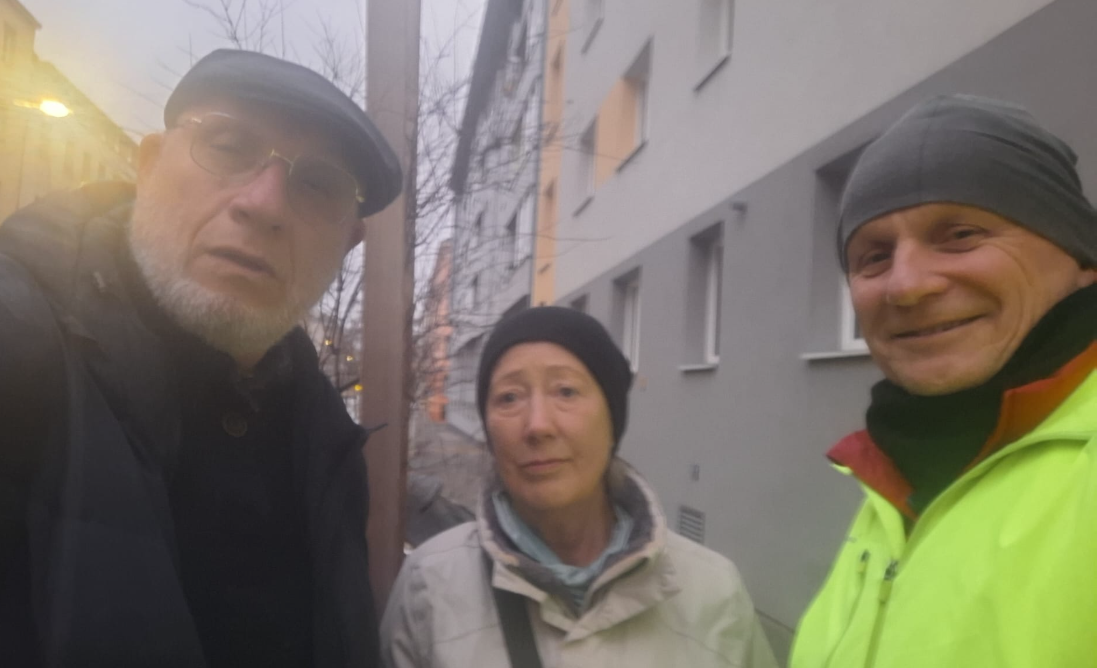
Agenda Team ‘Liveable 1150 West’
Georg-Josef had developed this agenda with Ullrike. Peter is assisting us with his expertise.
Georg-Josef developed this agenda together with Ulrike. We are supported by Peter, who contributes his technical expertise and is also involved in the Agenda Rad im Fünfzehnten (Bicycle Agenda in the Fifteenth) and the Agenda Grün statt Grau (Green Instead of Grey Agenda). This networking of different agendas was and is a valuable basis for exchange and for shared perspectives in the district.
At the beginning, many citizens had high hopes for the district agendas – the hope of being able to quickly implement their own ideas and achieve visible changes in their neighbourhood. Over time, however, it became apparent that not all expectations could be met immediately. For some of those involved, time constraints played a role, while for others, the complex coordination process with the administration and politicians led to a certain disillusionment.
The initial momentum gave way in some cases to a more realistic assessment of the possibilities and framework conditions. Nevertheless, concrete progress was made: Goldschlagstraße and Meislstraße were redesigned as so-called cycle streets. Further steps – such as greening measures and a careful revitalisation of the street space – are still pending for the remaining alleys in Neu-Penzing.
There would be enough space for additional trees and green areas without necessarily having to remove parking spaces that are important to many residents.
At the same time, it must be taken into account that we are in a densely built-up block of houses, where a high proportion of the residents have a migration background and around half of the houses do not have their own garages. Many people therefore depend on cars to get to work. These social and infrastructural realities make it clear that changes in public space must be made sensitively, gradually and in dialogue with residents.
These experiences in particular show how important long-term commitment, mutual understanding and realistic goals are in order to achieve sustainable improvements in the district.
Vienna in transition – a personal perspective (1970–2020)
I am a typical Viennese – in the best sense of the word, a mixed breed. Some of my grandparents come from the Krkonoše Mountains and Prague, others from Hungary, and then there are several generations from Vienna. This mix shaped my view of the city, society and development at an early age.
Back in 1966, I was a student at HTLBV and later a holiday intern to earn some extra money. At the time, my mother was working as a freelancer with the City of Vienna. In an era long before computers, digital maps and satellite images, aerial photographs were still taken by reporters from aeroplanes – in systematic series of images from a bird’s eye view, comparable to what satellites do today.
As I had a strong photographic memory and was able to visualise cities spatially ‘from above’ at an early age using city maps, I was asked if I could match these aerial photographs to the respective city maps and streets – which I did.
Even then, I realised that planning is always also interpretation: the vision of a generation or a planning team does not necessarily have to coincide with the urban vision of future generations.
In 1970, I was already living in Vienna, at a time when the city – like many other European metropolises – was being intensively planned, built and redesigned. From an early age, I was confronted, albeit indirectly, with questions of public space design. This gave me an understanding of how difficult it is not only to formulate new ideas, but also to implement them under real political, economic and social conditions.
Since that time, Vienna has been governed continuously by the same political force as the main actor. This political continuity has shaped the city as much as it has its inhabitants. Vienna changed – sometimes slowly, sometimes noticeably, often with a delay. And that was not only a disadvantage.
History of Neu-Penzing in the context of Vienna
The district known today as ‘Neu-Penzing’ – the area between Beckmanngasse, Hütteldorfer Straße, Johnstraße and Fenzlgasse in the westernmost part of Rudolfsheim-Fünfhaus (15th district) – is part of a long urban development that began in the 18th century and has continued for almost 300 years.
There is a wealth of information available on this topic, which NADEUM-WIKO has summarised on a separate page: Historical background of ‘NEU PENZING’
From 1970 to the present day 2025
1970 – The car-friendly city
- Urban planning heavily focused on private transport
- Roads, intersections and parking spaces were the main focus
- Public space primarily used as traffic areas
- Citizen participation existed, but was highly hierarchical
Further information:
1980 – Public transport as the backbone
1980 – Public transport as the backbone
- 1978 Opening of the first underground line (U1)
- Expansion of a modern underground network
- Trams remain in service
- Political continuity ensures stability
Further information:
1990 – Densification and everyday life
1990 – Densification and everyday life
- Population growth and redensification
- Street spaces are functional but not very liveable
- Large parks are available, but asphalt dominates
Further information:
2000 – Sealing and first warning signs
2000 – Sealing and first warning signs
- Increase in motorised traffic
- Road surfaces increasingly used as parking spaces
- Discussions about urban heat islands begin
Further information:
2010 – New momentum, new conflicts
2010 – New momentum, new conflicts
- Political openness to new urban development approaches
- Expansion of cycle paths, traffic calming measures
- Introduction of the €365 annual ticket (2012)
- Conflicts between generations become apparent
Further information:
2020 – The pandemic as a turning point
2020 – Pandemic as a turning point
- COVID-19 changes the use of public space
- Parks and pavements gain social significance
- Temporary traffic measures demonstrate the feasibility of change
- Cross-generational rethinking
Further information:
Personal conclusion
My observations are subjective, shaped by decades of living and working in Vienna. However, they are consistent with the historical developments of the city. Vienna has done a lot right – modern public transport, cultural diversity, social infrastructure. At the same time, the task remains of designing streets, alleys and squares as shared living spaces – especially in view of a warming climate and the growing needs of urban society.
Rudolfsheim-Fünfhaus in transition – personal experiences 2020–2025
2020–2021: A city in a state of emergency
The years 2020 and 2021 were also marked by the COVID-19 pandemic in Vienna. Public spaces changed their significance: pavements, squares and streets became places for small, informal encounters. At the same time, it became clear how scarce freely usable space actually is in densely built-up districts.
During this time, a political decision was made that would have a long-term impact: outdoor cafés no longer had to be dismantled for the winter. What was initially intended as a crisis measure turned out to be a sensible step against unnecessary waste of resources – and a door opener for new forms of street use.
2022: Network expansion in our own district
In 2022, I consciously began to expand my network in the residential district of Rudolfsheim-Fünfhaus (1150). I sought out conversations with people who, I hoped, would at least understand, if not share, my vision for the future of public space.
Intensive discussions took place with representatives of the Green Party in the district about the lack of quality of life in the street space. At the same time, it became clear that parts of the ‘old guard’ in the district continued to strongly prioritise the car culture. Even the idea of a superblock modelled on Barcelona was clearly rejected at that time.
Looking back, it can be said that time was nevertheless working in my favour. The Green Party had provided important impetus in the previous city government – something that was hardly imaginable for conservative socialists at the time. As the opposition, however, they brought a breath of fresh air to the urban debate.
2023: Participation, agenda work and the parklet
2023 was an extremely active year. In a pub called Velobis on the corner of Johnstraße and Linzerstraße, an intense discussion took place with the new district chairman, Ing. D. Baurecht, and the then district chairwoman from the 14th district. The district’s goal was to involve the population directly in change processes through newly established agendas.
I was fortunate enough not only to become part of existing district agendas, but also to co-found a new agenda myself. In August 2023, I was also accepted into a steering group.
Several meetings were held throughout the year as part of the Rudolfsheim-Fünfhaus (RH5) agenda. The aim was to make the westernmost part of the district more climate-friendly – with the involvement of all citizens who wanted to participate.
In the second quarter of 2023, approval was finally granted for a parklet. The person who originally submitted the application was unable to implement the project. At a meeting, the question was asked who would like to take it over. I volunteered.
This presented an opportunity to create something with a future in our alley: a consumption-free public space approved by MA46 – but with responsibility.
In August 2023, the parklet, designed by an architect, was built together with other committed individuals – at almost 40 °C in the shade. Reactions ranged from outrage at the loss of two parking spaces to speechless amazement and fears of noise.
The reality:
It wasn’t noisy.
The environment did not deteriorate.
There was no vandalism.
2024: Consolidation (permanent establishment) and infrastructure
From winter 2023/24 onwards, thanks to a decision by the responsible city councillor, both sidewalk cafés and approved parklets will remain in place all year round. This eliminates the need for annual assembly and dismantling and a considerable expenditure of resources.
In 2024, together with committed local residents, we succeeded in having a hydrant opposite the parklet (already located in the 14th district) replaced. It was opened as a public drinking fountain.
This was not only a symbolic success: until then, water had to be laboriously carried down from the fourth floor to water the plants in the troughs. From the second quarter of 2024 onwards, this work became noticeably easier – after all, I wasn’t getting any younger.
2025: Everyday life, acceptance and new realities
In 2025, additional flower boxes were installed. Unfortunately, some of them disappeared, as did individual plants. Whether this was due to rejection, carelessness or the widespread misconception that public means ‘freely available’ cannot be said with certainty. Rubbish and littering also increased slightly – a familiar phenomenon in public spaces.
As in previous years, an open meeting was held during Advent in 2025. In 2023 and 2024 – both election years – numerous district and city politicians were in attendance. In 2025, however, a busy year of events demanded a lot of stamina from everyone involved.
The parklet has now become part of the street. No one gets upset about it anymore. That’s good – but it also shows that for many in the district, it is simply too far away. It can only be reached on foot or by bicycle.
On 13 December 2025, the weather was not very inviting: damp and cold, with high fog and no snow. Nevertheless, there was apple punch, hot spiced tea and Christmas biscuits. Since around 2000, the once snowy Advent season in Vienna has increasingly given way to grey dampness.
Outlook
2025 is drawing to a close.
2026 is already quietly approaching.
The parklet remains.
As a place to meet.
As a sign that change is possible – step by step, in small ways, but with impact.
If you want to know more, you can find us in the WhatsApp group 1150 West, provided you give us your phone number. But the district and the city of Vienna itself, as well as their Local Agenda LA21 and the Agenda Grätzllabor, also have plenty of information for interested citizens on social media.
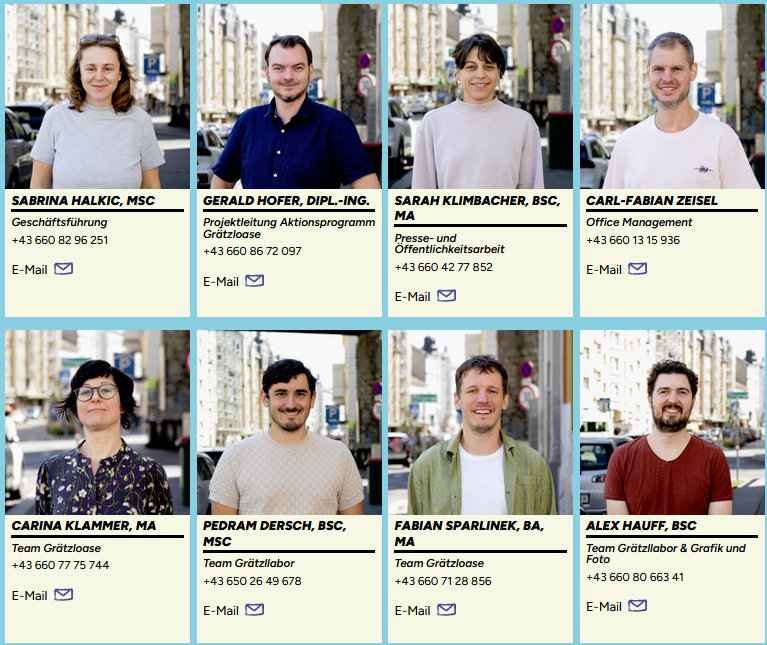
Local Agenda 21 Vienna Association
The Local Agenda 21 Vienna association supports citizen participation and empowerment at the local level in the context of sustainable development. The association works closely with the city administration, district politicians and civil society to enable opportunities for participation for all Viennese citizens at the local level. The work of the Local Agenda 21 Vienna team focuses on managing the Grätzllabore (neighbourhood laboratories) in twelve Viennese districts and implementing the Vienna-wide Grätzloase action programme. The team is therefore the hub for questions and concerns from all partners who are working together on the successful implementation of the Local Agenda 21 Vienna association's citizen participation programmes.
Sabrina Halkic, MSC
Management
+43 (0)660 82 96 251
E-Mail:s.halkic@la21.wien
Gerald Hofer, Dipl.-Ing.
Project Manager, Grätzloase Action Programme
+43 (0)660 86 72 097
Email: g.hofer@la21.wien
Sarah Klimbacher, BSc, MA
Press and Public Relations
+43 (0)660 42 77 852
Email: s.klimbacher@la21.wien
Carl-Fabian Zeisel
Office Management
+43 (0)660 13 15 936
E-Mail:f.zeisel@la21.wien
Carina Klammer, MA
Team Grätzloase
+43 (0)660 77 75 744
Email: c.klammer@la21.wien
Pedram Dersch, BSc, MSc
Team Grätzllabor
+43 (0)650 26 49 678
Email: p.dersch@la21.wien
o
Fabian Sparlinek, BA, MA
Team Grätzloase
+43 (0)660 71 28 856
Email: f.sparlinek@la21.wien
o
o
Alex Hauff, BSC
Team Grätzllabor & Graphics and Photography
+43 (0)660 80 663 41
Email: a.hauff@la21.wien
o