P004 ACAPMUSSC_MYC
ACAPMUSSC_MYC = ERASMUS+
African Community Action Programme for the Mobility of University Students and Skilled Craftspeople-as-well-as-Migrants, Youth-and-Children
„Aktionsprogramm der afrikanischen Gemeinschaft für die Mobilität von Universitätsstudenten und qualifizierten Handwerkern sowie Migranten, Jugendlichen und Kindern“
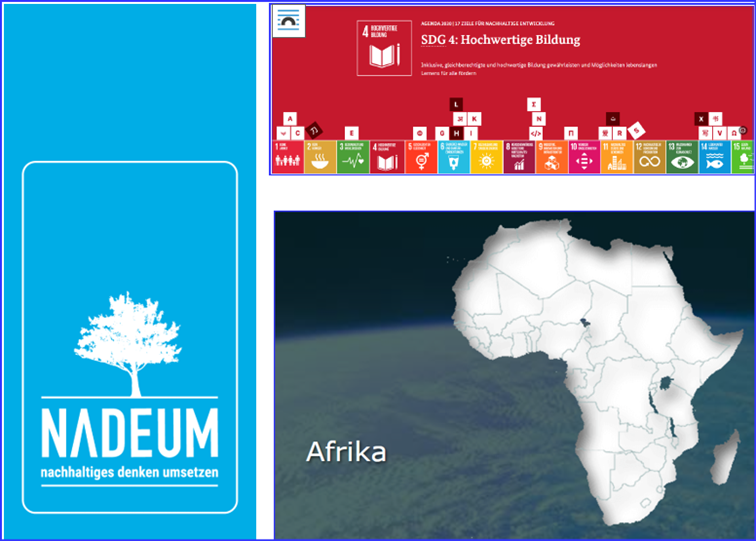
Table of contents
Explanation:
ACAPMUSSC-MYC is modelled on ERASMUS+. This EU (European Union) knowledge promotion project serves as a model for many countries. Several North African countries are seeking to participate in this programme and have already negotiated cooperation agreements with the EU. All countries that have entered into economic cooperation with the EU can also participate in this programme, provided that all requirements are met. ERASMUS+ is regarded as a peace project.
Nadeum-Wiko therefore asked himself: ‘Why shouldn't the AU, the African Union, make this possible for itself too?’
NADEUM-WIKO therefore asked itself why this could not also be implemented across the entire African continent with its 55 countries. After all, Africa has a very young population that is eager to learn new things. They just need to be given the opportunity to do so.
Three conditions must be met for this to happen.
1) The intention of all African governments to align their education systems with those of northern countries.
2) The intention to make this project accessible to all Africans from day one until the age of 30. ACAPMUSSC-MYC must offer future prospects to all sections of the population, such as internally displaced persons. It wants to become an active part of the global community of values.
3) The goal must be for Africa to create enough jobs and stop the exodus of young people with higher education in its own interest.
1. The project will make a direct contribution to the 17 Sustainable Development Goals. These goals were set by the United Nations and UNESCO.
1.1) Proposal for a UNESCO project to provide technical support for the modernisation of education systems in all African countries
1.2) Sustainable Development Goals:
1.3) SDG 1: Zero Hunger
1.4) SDG 2: Good Health and Well-being
1.5) SDG 3: Quality education
1.6) SDG 4: Gender equality
1.7) Creation of a sufficient number of high-quality jobs
1.8 Prevention of migration to northern countries
Introduction:
A brief introduction to the topic, including the background and relevance of the project, would be desirable. The introduction should introduce the reader to the topic and explain the context and relevance of the project. It would also be helpful if you could briefly describe UNIDO/UNESCO/UNICEF and their objectives to clarify the context.
NADEUM-WIKO:
Initiative 2015 – Migration flows to Europe, educational differences between Africans and the level of education in industrialised countries or service societies; Incompatibility of African qualifications – university degrees; extensive notification required; African labour markets are not competitive with the labour markets of industrialised countries or service societies – therefore, only a fraction of GDP can be generated. The NADEUM-WIKO initiative is relevant in that the education sector in Africa is to be massively strengthened through budgetary reallocations in favour of education. This means that the entire education logistics must be given priority in national budgets, thereby strengthening national economies.
UNIDO: UNIDO's priorities or service modules are
· Industrial governance and statistics
· Investment and technology promotion
· Trade and competitiveness promotion
· Private sector development
· Sustainable energy and climate change
UNESCO:
Preamble:
‘Peace based solely on political and economic agreements between governments cannot secure the unanimous, lasting and sincere support of the peoples of the world. If it is not to fail, peace must be rooted in the spiritual and moral solidarity of mankind.’
SDG 17:
ISCED (International Standard Classification of Education)
CONFINTEA The core objective of the sixth international conference on adult education is to align adult education and non-formal education with existing international development and education programmes (e.g. Education for All – EFA, the United Nations Literacy Decade Literacy Decade – UNLD, the Decade of Education for Sustainable Development – DESD, Literacy Initiative for Empowerment – LIFE, the United Nations Millennium Development Goals – MDGs) and the integration of adult education and non-formal education into national development strategies. Sustainability/sustainable development should also be considered an important element in the thematic context.
· Education
· Science
· Culture
· Media policy
UNICEF:
· Strengthening existing knowledge structures
· Searching for new solutions and influencing political decision-makers (collecting facts and figures)
· Knowledge can only be disseminated and developed through intensive exchange. We are committed to international and interdisciplinary communication.
· Responsibility of governments
· Realisation of children’s rights (children’s rights)
· Strengthening local initiatives
2. The emergence of an idea from the events surrounding the massive influx of migrants into the EU in 2015
(2.1) It would be interesting to know what considerations led NADEUM-WIKO to support the idea of ACAPMUSSC-MYC.
NADEUM-WIKO, its president and the entire executive committee recognised as early as 2015 that African qualifications might not achieve the desired results in Europe. Unfortunately, we had to conclude that the grades and certified knowledge did not serve their purpose.
2.2) It is quite understandable that many Africans had the financial backing of their families and therefore came to Europe, England or the USA to obtain a proper education. Their goal was to continue their education at a knowledge-based level and to apply the knowledge they had acquired either in industrialised or service-oriented countries or to use it in their home country to create new, promising career prospects.
2.3) Unfortunately, it must be noted that even if they wanted to, African migrants had little chance of finding a well-paid job when competing with European workers.
2.4) NADEUM-WIKO stated that Germany had a special ERASMUS programme with the Sahel countries. It is regrettable that corruption had reached such proportions that the funds earmarked for the training of apprentices did not reach the population eager to learn, but instead seeped away into the upper echelons of the state. It might therefore be advisable to suspend further payments until the situation improves sustainably. Germany therefore decided in 2023 to suspend this project for the time being.
2.5) At the time, the European Commission concluded that this learning programme could best be implemented within the framework of ERASMUS+. In 2023, ERASMUS+ was launched with the approval of all 26 EU member states. From the 2023/2024 training year onwards, all journeymen and master craftsmen in skilled trades will have the opportunity to participate in ERASMUS+ if they wish. As a result, the industry will give preference to hiring and recruiting these new employees after they graduate.
There are several reasons why these people are of interest to the industry. These include, for example, their cosmopolitan outlook, their good contacts, their language skills and their positive attitude towards new opportunities. These people usually marry internationally, which can be of great benefit to the economy.
3. The project should have clear and specific objectives.
These should be formulated according to the SMART principle (specific, measurable, achievable, relevant and time-bound). This helps to set clear expectations and measure progress.
3.1 Maximum dissemination of knowledge to all sections of the population.
3.2) This would enable all African countries to increase their budgets. After all, when the population is better informed and more skilled, the state benefits greatly.
3.3) The expansion of knowledge must also be accompanied by higher-quality jobs. This will enable Africa to catch up with other service and industrial countries worldwide.
3.4) This project would be important for the entire African continent in order to gain respect not through demands but through performance. Delegating may be part of the culture in Africa, but globally, you have to be able to do something. However, if the majority of Africans currently cannot have their qualifications recognised in industrialised countries and have to learn almost everything from scratch, then that is wasted learning time. So if ACAPMUSSC-MYC is implemented, every African must prove that they have mastered the material.
If ACAPMUSSC-MYC is supported by UNIDO with its economic agenda, UNESCO with its knowledge and ISCED programme, and UNICEF with its global experience, Africa should be able to implement this project by 2040. It should then be evaluated and continued every year. ERASMUS+ is also constantly being expanded and improved. The same applies to ACAPMUSSC-MYC. There must be no standstill.
4. Problem definition:
4.1) Rampant corruption among government officials and people in positions of power is currently a problem.
Anti-corruption laws, which are already enshrined in law in some African countries, should be introduced throughout Africa, provided that the funds earmarked for this purpose are actually used for this purpose.
4.2) There is reluctance to share the knowledge acquired with the general population.
4.3) Given the continuing population growth in Africa, well-educated professionals and academics of both genders are essential to increase GDP and offer fair opportunities for advancement to all citizens.
5. Methodology:
The following is an overview of the methods and approaches planned to achieve the project objectives. Detailed description of the methods and approaches to be used to achieve the project objectives. This may also include a description of the planned activities and measures.
5.1) The curricula must be developed in consultation with UNESCO and taking into account the needs of the respective countries and their experts. NADEUM recommends the European kindergartens in Germany, Sweden, Denmark and Austria. In the early years, the programmes of Caritas International could also be used. If African countries wish to implement this programme, they must contact partner institutions in Europe or other countries.
5.2) Strictly religious school systems should be rejected. They lead to radical views and are detrimental to economic progress and modernisation.
(5.3) Empathy, ethics, natural history and the connections between nature and climate should be taught from early childhood in order to raise children’s awareness in the long term.
6. Expected results:
Describe the expected results and the method for measuring them. This will help in evaluating the success of the project.
(1.) Since all UN member states have adopted and are guided by the UNESCO ISCED 1–8 programme (NADEUM recommends 1–9) from 2011, ACAPMUSSC-MYC should be subordinated to this programme. This would enable Africa to fully implement the international standard and its certificates or diplomas would have to be recognised by all states. The excuse or self-protective stance of the currently leading industrial and service states towards their own populations would then be invalid. This is because human rights and equality apply to all people in all legal situations (UN rights).
(6.2) All reports would become superfluous and both global and African industry would benefit to the maximum. However, employers must provide their employees with appropriate further training. Every company should grant its employees employment contracts that comply with human rights.
(6.3) NADEUM recommends: If all African states were to introduce a set of rules that complies with European labour law, the African continent would be more attractive to its own population than dangerous migration. Every trained employee represents a loss of value for a country if it fails to provide sufficient jobs for its own population. Currently, corporations are exploiting African countries as cheap workbenches. This does not have to be the case. To put it bluntly: where is the pride of Africans? You have the potential. Have confidence, and you will be richly rewarded.
ACAPMUSSC-MYC and African countries could exchange knowledge on an equal footing with industrialised countries if this programme were implemented on a continuous basis. For example, they could conclude a cross-union knowledge exchange agreement with Europe and its ERASMUS+ programme. This would benefit both continents.
7. Schedule:
Create a detailed schedule with important milestones and timeframes for the project. Create such a schedule for your project. This will help you track progress and ensure that the project is running according to plan.
If the P004 ACAPMUSSC-MYC project is accepted by the three UN organisations UNIDO, UNESCO and UNICEF, Africa can expect a time horizon of at least until 2050.
7.1 Acceptance of the NADEUM-ACAPMUSSC-MYC concept:
(From 2025: ‘NADEUM-WIKO ACAPMUSSC_MYC concept’)
As is customary with large institutions, such as states and their negotiating teams, an implementation phase of up to five years must be expected if all states evaluate this project positively.
7.2) Why?
Even though it only affects Africa, the adoption of this project is a global issue.
7.2.1) Who is responsible? (The African states themselves, but also the AU.)
7.2.2) Who negotiates with the African states? All global donors as well as the UN and its relevant sub-organisations.
7.2.3) Who is your mediator? Leading figures from UNIDO, UNESCO or UNICEF who are capable of handling such complex projects.
7.2.4) Who accompanies the African states?
NADEUM-WIKO would recommend the EU.
Why?
7.3) The European Union is a peace project and strives for peaceful cooperation. The EU refers to the Commission, not the individual EU Member States.
7.3.1 Furthermore, ACAPMUSSC-MYC should never lose sight of the goal of a cross-union knowledge contract with the EU. Both ACAPMUSSC-MYC and ERASMUS+ lead to maximum knowledge growth. This secures the economic future and ultimately leads to maximum benefit for all parties involved in future joint sustainable climate planning.
7.3.2) The African states adopt the concept. Each state should conclude a treaty with UNIDO/UNESCO/UNICEF in which the UN authority supports the respective state. NADEUM-WIKO also expects negotiations to take at least five years in this case.
7.4) All African states are positive about this development and peace project, which is the most sustainable for them. From this point on, wars in Africa must be ended. The Olympic ideal should be adopted. All African states agree with the African Union in a bilateral knowledge agreement to implement ACAPMUSSC-MYC on a permanent basis in accordance with the rules to be developed.
(7.5) Once all 55 African states have signed this sustainable African knowledge, peace and development agreement, the AU (African Union) should issue government bonds to enable green capital for the development of this project. The African Central Bank could thus generate money more cheaply. In addition, it would be advisable to introduce a currency that is as uniform as possible (or a fixed exchange rate) in Africa.
The financing of the individual states is secured and implementation can begin.
7.6.1 Planning of the most important points: – Logistics (construction of the campus),
– Public transport (rail, road, ship and possibly aeroplane),
– Coordination of construction progress.
7.6.2) Tendering for all public construction and logistics areas. (The strictest guidelines apply, as with UN or EU projects.)
7.6.3) Preparation of the budgets of all African states.
7.6.4 Each state is obliged to allocate 2% of its GDP per phase to its ACAPMUSSC-MYC project (NADEUM recommends 9%) .
7.6.5) All current industrialised countries and Asian countries should grant African countries an interest-free loan for knowledge building with a term of ten years.
All construction projects should then be put out to international tender.
7.6.6) NADEUM-WIKO recommends finding a balance here. What does that mean? The cheapest provider is rarely the most sustainable. Internationally renowned institutions should be provided by the UN to support Africa.
Note:
With regard to China, it should be noted that it defines itself as a developing country and thus evades any global responsibility. If this country wants to be the future economic power of the world, it must give up this status. It behaves like a child who demands the respect of adults as it grows older. If you want to be an adult, you have to act like one.
7.7) Which institutions are involved in this government programme?
7.7.1) All childcare facilities that care for children from birth to the age of five and prepare them for entry into primary school are to be rebuilt.
7.7.2) All primary and secondary schools, as well as all higher education and training institutions. Technical colleges, universities and private institutions.
7.7.3) All private research institutions. Likewise, industry, companies and research institutions that want to take on the staff as workers.
Overall, the implementation period is expected to take between five and 30 years, depending on the will of the respective government representatives.
7.9 Each state will take different steps that are important to it, in accordance with its culture.
8. Budget:
Please provide an estimate of the funds and resources required. This may also include a breakdown of costs by category.
Africa and its states can finance the ACPMUSSC-MYC programme themselves if necessary. If loans are required at all, they should be subject to certain conditions.
For example
– that migration to other countries is prevented
– attractive prospects should be offered to the local population
– guaranteed jobs for future employees should be created through tax breaks for interested industry and business.
8.2) What does the financial plan look like in concrete terms? If Africa wants to catch up with the rest of the world, at least €8 billion in investment funds per year must be estimated per level of education and per country. In 2023, the entire African continent, comprising 55 countries, had a GDP of almost 3 trillion US dollars or 2.7 trillion euros (exchange rate August 2024).
Assuming that African countries can invest an additional 2% of their GDP in the education sector plus logistics, the following calculation results:
o The average GDP of all countries is 2,696.70 billion euros (August 2024).
o 2% of the GDP of all countries: 2,696.70 billion euros divided by 100 times 2 = 53.94 billion euros.
o 55 countries: 53.94 billion euros divided by 55 = 0.98 billion euros per country per year.
This amount would have to be made available for each level of education, including logistics (total package). According to the UNESCO ISCED 1–8 classification, this results in 0.98 times 8, or 7.85 billion euros per year for all levels.
With regard to the Austrian education system, NADEUM-WIKO recommends the introduction of an additional level (number 6 of 9 levels), which is listed in the following table, in order to train skilled workers and corresponding trainers. This results in a newly calculated financial requirement of 0.98 billion euros per year and federal state per level of education, i.e. a total of 8.82 billion euros per year for all levels.
What is included in the project budget?
8.5.1) All new buildings, the expansion of transport facilities, adapted and new schools, campuses, accommodation, scholarships and intra-continental or international exchange programmes (such as the European Union’s ERASMUS+ programme for students, including craftsmen and trainers).
Provided that the programme is implemented appropriately, as was the case for the European area under ERASMUS+, it can be assumed that the minimum duration of the basic programme in Africa will be 40 years. For guidance, the European Union needed the period from 1947 to 1987 to prepare ERASMUS for signing.
| Type of educational institution | Type of educational institution | Type of educational institution | Type of educational institution | |
1 | Nursery or toddler group in a daycare centre | 0,98 |
|
| |
2 | Kindergarten | 0,98 |
|
| |
3 | Preschool | 0,98 |
|
| |
4 | Primary school | 0,98 |
|
| |
5 | Secondary school | 0,98 |
|
| |
6 | Technical colleges and teacher training colleges | 0,98 |
|
| |
7 | Grammar schools | 0,98 |
|
| |
8 | Campis | 0,98 |
|
| |
9 | Colleges and universities | 0,98 |
|
| |
9. Conclusion:
Summarise the most important points and ask for support or cooperation. This is also a good opportunity to emphasise the importance of the project once again.
9.1) Cooperation with UNESCO and UNIDO is being sought, as both UN institutions support the further development of the holistic education sector in African countries. If they support this programme, NADEUM can assume that ACAPMUSSC-MYC will also achieve the project goal.
9.2) All participating countries whose institutions would impart theoretical and practical knowledge would benefit greatly from this programme.
9.3) NADEUM is convinced that Africa will be the location of the FUTURE of this world. In the year 2100, for example, Africans should be able to travel into space as ‘African astronauts’ just as naturally as other astronauts.
9.4) According to current forecasts, Africa will reach a population of 4.2 billion by the end of this century. Africans must therefore be able to develop their continent sustainably in all ministerial areas, keep it habitable, end all wars and engage in constructive cooperation with all other continents. It is also crucial for Europe’s existence to have Africa as a strong partner and to be able to assume in the medium term that migration flows from Africa will be largely stopped and, in return, the exchange of labour will be promoted on both sides. This can only be guaranteed if the level of education and implementation potential of Africans reaches world standards.
L